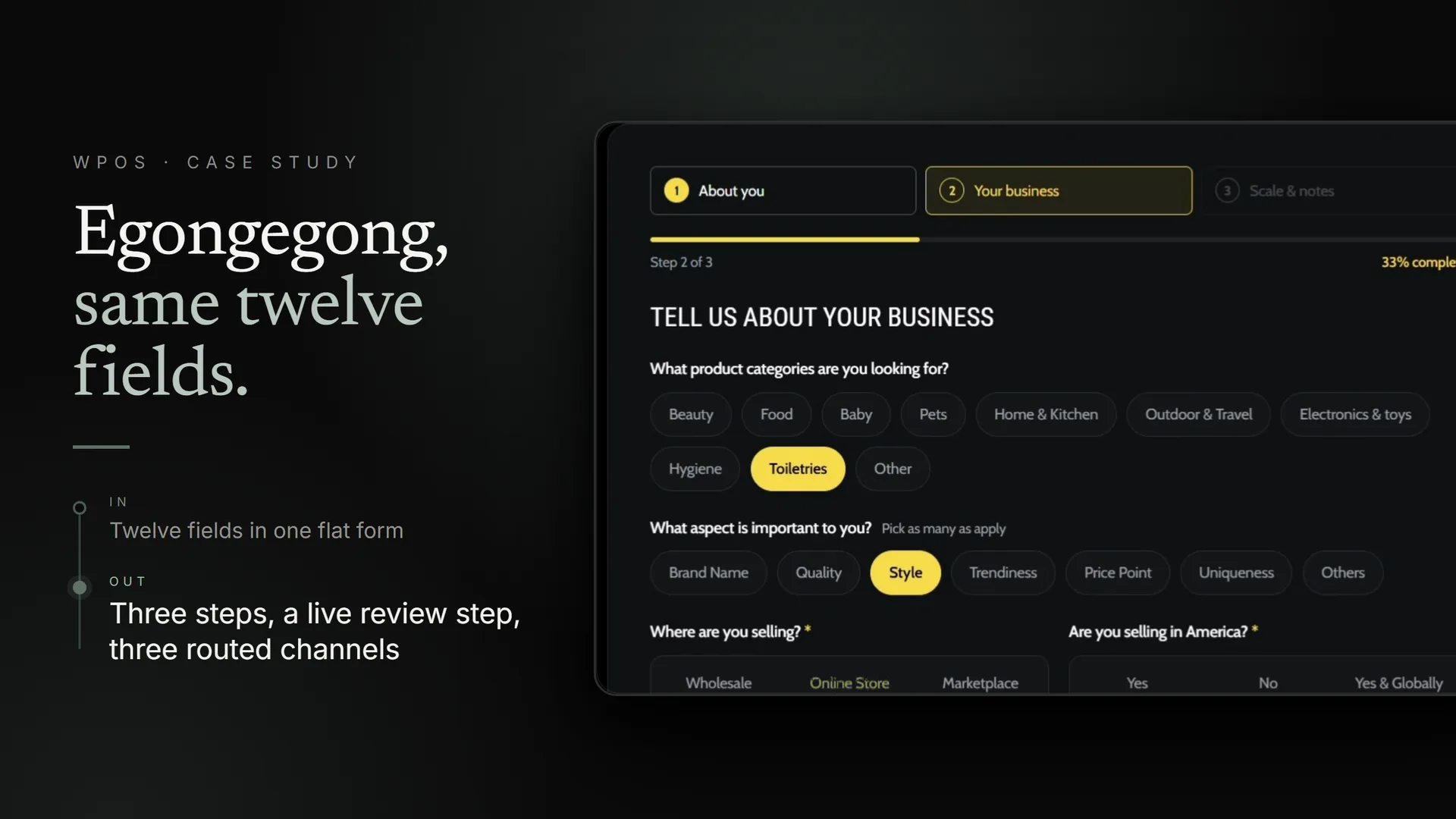
Same twelve fields. Completely different experience.
A wholesale sourcing brand's contact page ran a three-step plugin form — twelve fields, six required, and not much else. WPOS rebuilt the identical twelve fields with richer controls, real validation and a review step that shows people their own answers.
- 12 fields rebuilt
- 3 routed channels
- Live review step
- Validation on all 5 required fields
At a glance · measured, not assumed
- 12
- Fields rebuilt, same as the source
- 3
- Routed contact channels
- 5/5
- Required fields validating
- 1
- Stale-review bug caught by re-running
Watch the build
Twelve fields in. A contact experience out.
The brief
Here’s the link, redesign the form, fully detailed.
The form worked, technically. That is what makes this the common case: a plugin form with bare inputs, one email address behind it, and no sense of what happens after someone hits send. Nothing is broken enough to force a rebuild, and it quietly costs enquiries anyway.
The constraint worth noting is that the field list did not change. Twelve fields before, twelve after. Everything that improved came from how they were asked.
What WPOS did
It pulled the live page and inventoried it first — every field, the three contact channels, and the brand: black canvas, that yellow, Roboto Condensed and Cabin.
Then it rebuilt the same twelve fields as a proper contact experience. Richer controls instead of bare inputs, real validation, and a review step that shows people their own answers before they send — every response rendered as a readable label rather than a raw value.
The single email address became three routed contact cards, with a sticky what-happens-next column beside the form, trust chips, and an email fallback. Mobile collapses to a single column.
What it flagged about its own work
It found its own bug by re-running the flow properly rather than spot-checking it. The review block only built when you first entered that step — so any edit made on step three never appeared in the summary. A visitor would have reviewed stale answers and sent them believing they were correct.
That is the kind of fault a quick visual pass misses entirely, because the review step looks right. It patched it, then re-ran the whole flow end to end until all twelve answers updated live.
It was also clear about the limit: submit is not wired to a handler on this build. The form validates, reviews and collapses correctly, but it does not yet send. Stated plainly — one instruction away, and not presented as finished.
The results
- Twelve fields rebuilt with richer controls, from the same source field list
- Validation firing on all five required fields, verified rather than assumed
- A live review step rendering every answer as a readable label
- Three routed contact cards replacing one email address
- A sticky what-happens-next column, trust chips and an email fallback
- Mobile collapsing cleanly to a single column
- One self-caught bug — a stale review block — patched and re-verified end to end
- The unwired submit handler declared, not hidden
Technologies
What this build actually used.
- Platform: WordPress with WPOS, rebuilding a three-step Gravity Forms form as native widgets
- Source analysis: the live page pulled and inventoried first — every field, the three contact channels, and the brand tokens: black canvas, that yellow, Roboto Condensed and Cabin
- Fields: the identical twelve fields, rebuilt with richer controls instead of bare inputs
- Validation: real client-side validation, confirmed firing on all five required fields
- Review step: a live summary rendering every answer as a readable label rather than a raw value, so people can check their own answers before sending
- Contact routing: three routed contact cards replacing a single email address, with a sticky what-happens-next column, trust chips and an email fallback
- Responsive: collapses to a single column on mobile
- Debugging: the review block only built on first entry to that step, so edits made on step three never appeared — found by re-running the whole flow rather than spot-checking, then patched and re-verified end to end
- Not wired: the submit handler. The form validates, reviews and collapses correctly but does not yet send
FAQ
Can WPOS improve a form without changing what it asks for?
Yes. This rebuild kept the identical twelve fields and changed only how they are asked — controls, validation, review step and routing.
Does it replace plugin forms?
It can rebuild them as native widgets, as here, where a three-step plugin form became a native contact experience.
Does it tell me what isn’t finished?
Yes. On this build the submit handler is not wired, and that is stated directly rather than left for you to discover on the first real enquiry.
Start free
Start free for 30 days with 5,000 credits at wpos.ai. No card required, and nothing charges automatically. WPOS connects to any WordPress site, new or existing, on any host, and works alongside Gutenberg, Elementor, WooCommerce and Divi. Book a call with the founders at cal.com/algorismus/30min.
Your next WordPress site starts with a conversation.
30 days free. 5,000 credits, no card. Just describe what you need.
See It In Action