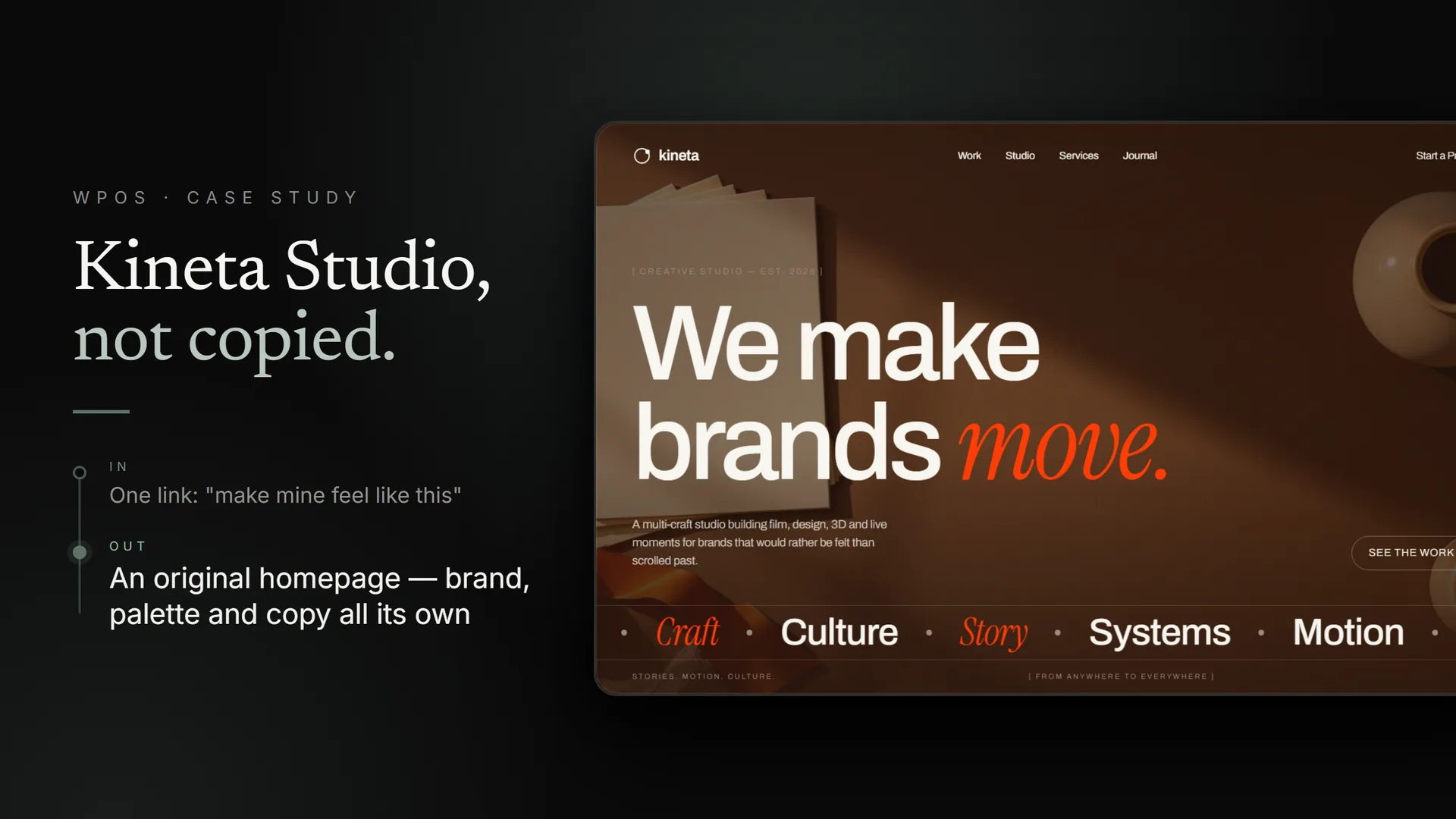
How WPOS matched a premium studio site without copying a pixel of it
A creative-studio homepage built from a single reference link — same premium feel, same motion language, none of the reference's photos, words or branding. WPOS sampled the real site instead of guessing at it, and found that the black everyone sees is actually a warm espresso brown.
- 8 sections
- 7 generated images
- 32/32 reveals verified
- 0 console errors
At a glance · measured, not assumed
- 8
- Original homepage sections
- 7
- Images generated to the sampled palette
- 32/32
- Scroll reveals verified as firing
- 0
- Console errors, no broken images
Watch the build
One reference link in. An original homepage out.
The brief
Build only the home page, matched to a reference site — and use none of their assets.
A client sends one link and says make mine feel like this. The agency cannot reuse a single asset, word or logo from it. That last clause is the entire job: matching a premium site’s feel while owning every pixel you ship is very different from matching its markup.
The session opens mid-project. WPOS reports where it left off on another build and what is still blocked, then the brief turns and it picks up the new work.
What WPOS did
It sampled the real site rather than eyeballing a screenshot. Opening the reference in its own browser let it read the actual values off the page — palette, type pairing and motion behaviour — instead of guessing from an image.
That is how it found the thing worth finding: the colour everyone reads as black is a warm espresso brown. A screenshot would have given a flat near-black, and the whole page would have felt subtly wrong.
From there it built eight sections in that design language, narrating each fix as it went: espresso brown against cream with one vivid orange-red, service rows that brighten as you pass them, a drag-scroll rail of work, a client marquee, and an oversized call to action that reveals word by word. Every image was generated to the palette, and the logo is an original SVG. It ran a verification pass across nine widths before handing the page over.
What it flagged about its own work
Mid-build it broke a different site, noticed, and said so. A second theme turned a neighbouring site’s buttons orange. WPOS reported the damage it had caused rather than leaving it to be discovered later, then fixed it.
It was equally direct about what it made up. The name Kineta Studio is WPOS’s own invention, created because the brief required original branding — not a real company, and labelled as invented rather than presented as a client.
That is the part worth paying attention to. Plenty of tools will build you eight sections. The useful question is whether you can trust the report that comes back with them.
The results
- Eight original homepage sections in the reference’s design language
- Seven generated images, all to the sampled palette, plus an original SVG logo
- 32 of 32 scroll reveals verified as firing — measured, not assumed
- Zero console errors and no broken images
- Nothing of the reference’s photos, copy, logo or branding used anywhere
- One self-inflicted fault on a neighbouring site, reported and fixed in the same session
Technologies
What this build actually used.
- Platform: WordPress with WPOS, native widgets — no page builder
- Reference analysis: the live page opened in a browser and sampled directly, rather than read from a screenshot — which is how the warm espresso brown was found behind an apparent black
- Theme: WPOS theme tokens — espresso brown, cream and a single vivid orange-red
- Imagery: seven generated images matched to the sampled palette
- Logo: an original SVG, not traced from the reference
- Motion: scroll-reveal animations across 32 targets, hover-brightening service rows, a drag-scroll work rail, a client marquee and a word-by-word call-to-action reveal
- Verification: rendering checked across nine viewport widths; console checked for errors
FAQ
Can WPOS match a reference site without copying its content?
Yes. It rebuilds the design language — palette, type pairing, layout devices and motion — using its own generated images, its own copy and an original logo. In this build, nothing of the reference’s assets, words or branding was used.
Does WPOS look at the real reference page, or just a screenshot?
It opens the reference in a browser and samples the live page. That is how it found the reference’s apparent black was really a warm espresso brown, which a screenshot would have flattened.
Does WPOS report mistakes it makes during a build?
Yes. In this session it turned a neighbouring site’s buttons orange with a second theme, reported that it had done so, and fixed it before finishing.
Start free
Start free for 30 days with 5,000 credits at wpos.ai. No card required, and nothing charges automatically. WPOS connects to any WordPress site, new or existing, on any host, and works alongside Gutenberg, Elementor, WooCommerce and Divi. Book a call with the founders at cal.com/algorismus/30min.
Your next WordPress site starts with a conversation.
30 days free. 5,000 credits, no card. Just describe what you need.
See It In Action