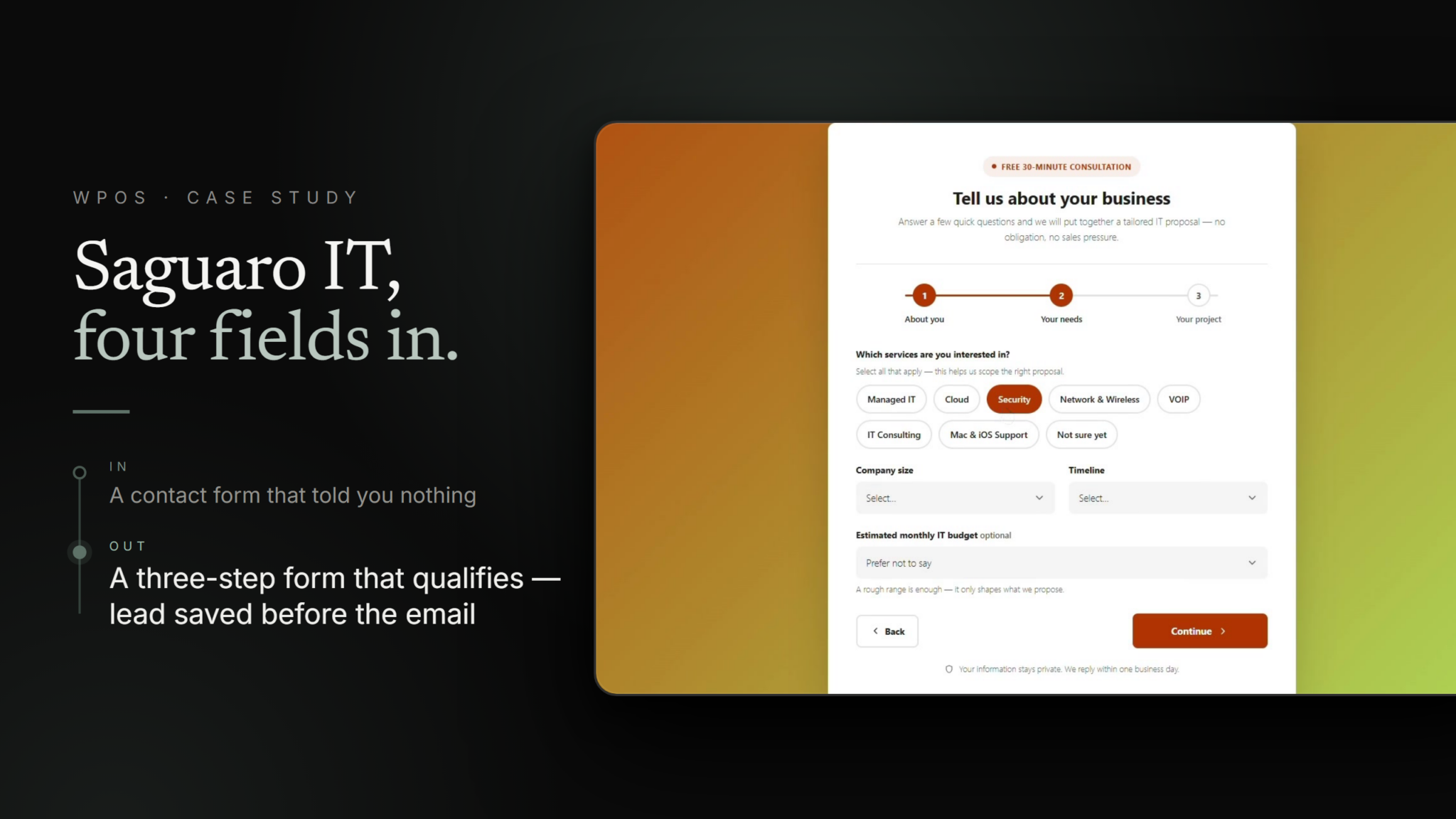
Four fields that told you nothing, rebuilt into a form that qualifies
A managed IT company’s consultation page asked for a name, an email, a phone number and a message. WPOS rebuilt it as a three-step qualifying form — and built a backend that saves the lead before the notification email is even attempted.
- 3 steps
- 8 service chips
- Lead saved before email
- 5/hour rate limit
At a glance · measured, not assumed
- 3
- Steps in the qualifying form
- 8
- Service chips capturing scope
- 5/hr
- Rate limit per IP address
- 0
- Leads a mail failure can destroy
Watch the build
Four fields in. A qualified lead out.
The brief
Here’s the link, build it with a detailed form. One line.
The underlying problem is one most service businesses have: the contact form collects the bare minimum, so every enquiry starts with a discovery call that could have been three form fields. And the form emails you — which quietly means a mail problem is a lost lead, and you will never know it happened.
What WPOS did
It read the live page, confirmed the layout, and pulled the real assets into the media library — header, gradient hero with the contact strip, form card, dark footer, plus the logos and desert photo.
Then it replaced the four fields with a three-step qualifying flow. About you. Your needs, with eight service chips, company size, timeline and budget. Your project, with a live 1,500-character counter, contact preference and consent.
The backend matters more than it looks. Each submission is saved as a lead record before the notification email is even attempted — so a mail failure cannot lose you a lead. Spam protection is layered: a honeypot, a three-second time trap, and a five-per-hour rate limit per IP.
What it flagged about its own work
It drove the finished form in a real browser rather than eyeballing it — submitting empty steps to confirm they block with per-field errors, then completing two full submissions and checking the records actually saved server-side.
That is how it found its own bug: the success screen was printing two messages, because the server’s generic reply was overwriting the editable copy. Fixed, retested, and then it deleted its own test leads rather than leaving fake records in the database for someone else to find.
The results
- Four fields replaced by a three-step qualifying form
- Eight service chips, company size, timeline and budget captured before the first call
- A live 1,500-character counter, contact preference and consent
- A REST endpoint that persists the lead before attempting notification
- Layered spam protection: honeypot, three-second time trap, five-per-hour rate limit per IP
- Validation confirmed by driving the real form in a browser, not by inspection
- One self-caught bug — a duplicated success message — fixed and retested
- Test leads deleted afterwards
Technologies
What this build actually used.
- Platform: WordPress with WPOS, replacing the existing four-field form
- Source analysis: the live page read and its layout confirmed — header, gradient hero with contact strip, form card, dark footer — and the real logos and desert photograph pulled into the media library
- Form: a three-step qualifying flow — About you; Your needs with eight service chips, company size, timeline and budget; Your project with a live 1,500-character counter, contact preference and consent
- Backend: a WordPress REST API endpoint that persists each submission as a lead record before the notification email is attempted, so a mail failure cannot lose a lead
- Spam protection: layered — a honeypot field, a three-second time trap, and a five-per-hour rate limit per IP
- Testing: driven in a real browser rather than eyeballed — empty steps submitted to confirm per-field errors, then two full submissions verified server-side
- Debugging: a duplicated success message traced to the server’s generic reply overwriting the editable copy; fixed and retested
- Cleanup: its own test leads deleted afterwards rather than left in the database
FAQ
What happens to a form submission if the notification email fails?
On this build, nothing is lost. The lead is written to the database first and the email is attempted second, so a mail failure cannot destroy the enquiry.
Can WPOS build the backend, or only the form’s appearance?
Both. Here it built a REST endpoint with lead persistence, a honeypot, a time trap and per-IP rate limiting.
Does it test the form, or just look at it?
It drives it. In this build it submitted empty steps to check validation, completed two real submissions, verified them server-side, and deleted its test data afterwards.
Start free
Start free for 30 days with 10,000 credits at wpos.ai. No card required, and nothing charges automatically. WPOS connects to any WordPress site, new or existing, on any host, and works alongside Gutenberg, Elementor, WooCommerce and Divi. Book a call with the founders at cal.com/algorismus/30min.
Your next WordPress site starts with a conversation.
30 days free. 10,000 credits, no card. Just describe what you need.
See It In Action